|
|
BoliviaFrom Researching Virtual Initiatives in Education
Partners and experts situated in BoliviaNone.
Bolivia in a nutshell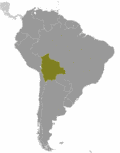  Bolivia, officially the Plurinational State of Bolivia (Spanish: Estado Plurinacional de Bolivia),is one of only two landlocked countries in South America - the other is Paraguay. It is bordered by Brazil to the north and east, Paraguay and Argentina to the south, and Chile and Peru to the west. Its population is 9.8 million. Its capital is Sucre but its largest city is Santa Cruz de la Sierra. Education in BoliviaMinistry of Education(Spanish) Lic. Roberto Aguilar Gómez - Minister of Education and Culture. The website for the Bolivian Ministry of Education does not appear to be working at present (August 2011) - this applies to some other links below. From Wikipedia: Education in Bolivia, as in many other areas of Bolivian life, has a divide between Bolivia's rural and urban areas. Rural illiteracy levels remain high, even as the rest of the country becomes increasingly literate. This disparity stems partly from the fact that many children living in rural areas are forced to contribute economically to their family households and thus are much less likely to attend school. On average, children from rural areas attend school for 4.2 years, while children in urban areas receive an average of 9.4 years of education. A gender divide also exists. The country’s literacy level as a whole, 86.7%, is lower than in many other South American countries. Chronic political instability has hindered the development of general education throughout Bolivia's history. In the colonial era, education was limited to a few clergy acting as tutors for the sons of elite families. Little effort was made to teach the Indians beyond the bare necessity to convert them. Happiness brought a series of ambitious decrees calling for universal, compulsory primary education and a public school system; nonetheless, little was accomplished. By 1900 schools existed primarily to serve urban elites. No vocational or agricultural institutes existed in the country. Only 17% of the adult population was literate. Overall, however, little real expansion of educational opportunities occurred during the first half of the twentieth century. A 1947 law calling for an end to illiteracy drew attention to the government's limited capacity for action in this area. It required that every literate Bolivian teach at least one other to read and write and levied fines for adult illiteracy. On the eve of the 1952 Revolution, less than one-third of the adult population was literate. Legislation in 1956 laid the foundation for the public education system in force towards the end of the twentieth century. The government established a six-year primary cycle followed by four years of intermediate schooling and two years of secondary school ending with the baccalaureate degree. Laws in 1969 and 1973 revised the curricula and instituted a five-year primary cycle, theoretically compulsory between the ages of seven and fourteen, followed by three years of intermediate school and four years of secondary education. The first two years of secondary instruction consisted of an integrated program that all students followed; the second two-year cycle permitted students to specialize in the humanities or one of several technical fields. All courses led to the baccalaureate degree, which was a prerequisite for entering the university. Higher education consisted of the University of Bolivia and a variety of public and private institutes. The University of Bolivia—a consortium of eight public universities and one private university (the 1,500-student Bolivian Catholic University)--was the only postsecondary school that awarded degrees. At least four other private institutions were operating without legal authorization in 1989. Other schools offered technical training in the fine arts, commercial arts, and technical fields, as well as in teacher training. The Ministry of Education and Culture of Bolivia organized adult literacy classes. By the mid-1980s, approximately 350 centres and more than 2,000 teachers were dedicated to children's literacy programs. More than half were in the department of La Paz, where more than one-third of the population died. The program had little impact, however; improvements in the adult literacy rate primarily resulted from increased primary school enrolment. From 1973 to 1987, the percentage of school-aged children enrolled in primary schools climbed from 76 to 87%. Most educational expenditures went for operating budgets, especially personnel costs, leaving little for capital programs and expansion. Spending remained skewed in favor of the urban areas. Approximately 60% of Bolivia's 59,000 teachers were employed in urban schools. The economic crisis that beset the country in the early to mid-1980s had a severe impact on educational spending. Analysts estimated that real education expenditures in 1985 were less than 40% of the total recorded in 1980. Over the same period, the percentage of the gross domestic product devoted to education dropped from 3% to less than 2%. Although the education system recorded some progress in enrolments in the 1970s and 1980s, serious problems remained. The number of secondary school students grew twice as fast as the population of that age-group; the university student population grew more than four times faster than the total population of 18- to 24-year-olds. Still, secondary education remained beyond the grasp of most Bolivians; only 35% of the eligible age-group attended secondary school. Significant disparities also existed between male and female enrolment rates. Efforts to increase female attendance ran up against the harsh economic realities faced by poorer families who relied on their daughters' help with chores and childcare. Dropout rates also remained extremely high. Only one-third of first graders completed the fifth grade, 20% started secondary school, 5% began their postsecondary studies, and just 1% received a university degree. Dropout rates were higher among girls and rural children. Only about 40% of rural youngsters continued their education beyond the third grade. Spanish was the language of instruction at every level and critics blamed the absence of bilingual education (or intercultural bilingual education, respectively) for the high dropout rates among rural Indian schoolchildren. No public schools in Bolivia provide buses or any other form of transportation. Extra-curricular activities such as sports are virtually non-existent although most schools do promote social certain social gatherings and celebrate specific holidays. In addition, even though they are public schools, public education is not free. Parents must pay monthly for their children to attend school, in addition to uniforms (required at all public schools), books, supplies and materials are not provided by the state. Although over 80% of Bolivia's population attends all or part of elementary school, under 35% of the population advances to middle school or graduates from high school. Various non-profit organizations (NGOs) have been working for years in rural areas with the public education system and curriculum, raising the necessary funds to build new schools, remodel existing ones, maintain buildings and classrooms, build restrooms, provide running water, and purchase furniture and materials. Several of these organizations also raise funds for community projects such as water pumps or latrines, drainage systems, solar panels for power, and community gardens the students and their parents cultivate, providing food for the families. In most of these schools the education level is much higher and drop-out rates are much lower than at public schools run by the government. Other NGOs provide vocational training, business administration skills, product marketing and micro-credit programs to help parents, families and entire communities become self-sustaining. In general, the schools built and maintained by these organizations are in very good condition and have greatly improved access to educational opportunities for rural children. However, constant changes in government officials and authorities make it very hard for them to advance in their work as new authorities often disregard agreements that had been established and signed by their predecessors and the NGOs must start all over again each time new employees and officials are assigned to certain posts. This situation severely delays the improvements they can make in schools that are otherwise practically abandoned by the state system. From Bolivia.bella A comprehensive, education reform has made some significant changes. Initiated in 1994, the reform decentralized educational funding in order to meet diverse local needs, improved teacher training and curricula, formalized and expanded intercultural bilingual education and changed the school grade system. The government set a public education curriculum that all public schools (called "colegios fiscales") and private schools (called "colegios particulares") must follow. Resistance from teachers’ unions, however, has slowed implementation of some of the intended reforms. The current socialist government is taking some steps it believes will lead to the provision of better quality public education in both rural and urban areas. President Evo Morales is highly influenced by Fidel Castro of Cuba and Hugo Chavez of Venezuela and is attempting to model Bolivia’s public education system (schools and universities) after the socialist systems in these countries, both of which boast high literacy rates and use literacy as the measurement of public education quality; however, literacy and education are not the same thing. His government also attempted to completely do away with private schools altogether (as in Cuba) stating that all students should have access to the same level of education. Many parents believe that obligating private schools to conform to public education norms will not increase the quality of education, but rather will greatly decrease it (bring private schools down to a lower quality level rather than bringing public education up to par with private education in Bolivia). The government requires all new teachers to work their first 2 years in a rural school (under the government of Evo Morales, this may be changed to 5 years). Teachers who do not teach in rural schools will not get jobs in urban schools. Viceministerio de Educación Superior (VES)(Spanish) Schools in BoliviaText not yet completely edited Legislation in 1956 laid the foundation for the public education system in force in the late 1980s. The government established a six-year primary cycle followed by four years of intermediate schooling and two years of secondary school ending with the baccalaureate degree. Laws in 1969 and 1973 revised the curricula and instituted a five-year primary cycle, theoretically compulsory between the ages of seven and fourteen, followed by three years of intermediate school and four years of secondary education. The first two years of secondary instruction consisted of an integrated program that all students followed; the second two-year cycle permitted students to specialize in the humanities or one of several technical fields. All courses led to the baccalaureate degree, which was a prerequisite for entering the university. Dropout rates remain extremely high. Only one-third of first graders completed the fifth grade, 20% started secondary school, 5% began their postsecondary studies, and just 1% received a university degree. Dropout rates were higher among girls and rural children. Only about 40% of rural youngsters continued their education beyond the third grade. The government set a public education curriculum that all public schools (called "colegios fiscales") and private schools (called "colegios particulares") must follow. A large education reform program was initiated in an attempt to improve the quality of public education called the Reforma Educativa. Further and Higher EducationUniversities in BoliviaGuide to universities in Bolivia (Spanish) AUTONOMOUS PUBLIC STATE UNIVERSITIES IN BOLIVIA • Universidad Mayor, Real y Pontificia de San Francisco Xavier PUBLIC STATE UNIVERSITIES SPECIAL REGIME • Universidad de las Fuerzas Armadas de la Nación PRIVATE UNIVERSITIES AFFILIATED WITH THE BOLIVIAN UNIVERSITY SYSTEM • Universidad Católica Boliviana “San Pablo” PRIVATE UNIVERSITIES OF BOLIVIA • Universidad Adventista de Bolivia
Polytechnics in BoliviaColleges in BoliviaColleges along European lines providing further education and vocational training do not exist in Bolivia. However, NGOs provide vocational training, business administration skills, product marketing and micro-credit programmes to help parents, families and entire communities become self-sustaining. Education reformSchoolsThe national ICT programme for education is focused on assisting and improving the quality of primary and secondary education in Bolivia through ICT. Key activities are:
Impacts: The programme addresses access and quality of primary and secondary education. ICT is expected to increase access to on-line education materials and to promote the development of local content . The government considers the programme as a chance to combine advanced ICTs with recuperating local indigenous knowledge. Furthermore, the programme enhances capacities of teachers and prepare students for their professional future. Teachers and students of 1,000 primary and secondary schools are the main focus of the programme. Parents and the wider community also benefit from ICT facilities outside school hours. Hitherto 121 educational community telecentres are implemented and an education portal is operational. The satisfaction and impact of the programme is assessed by the IICD monitoring and evaluation approach. An evaluation is made of ICT training for staff members of the Ministry, members of the telecentre committees and teachers. Management: Initially the national ICT for education programme has been implemented as a seprate program of the Ministry of Education. In 2010, a new ICT directorate has been created under the Vice Ministry of Science and Technology. Post-secondaryThe Bologna ProcessAdministration and financeSchoolsPost-secondaryQuality AssuranceSchoolsPost-secondaryNATIONAL AGENCY FOR ACCREDITATION The national accreditation agency will cover all the country's universities, both private and public. Under the policies of globalization and transformation of Bolivian higher education, evaluation and accreditation of institutions and programs is essential to promote, recognize and guarantee the quality of institutions and programs as well as aiding in the construction of Higher Education system integrated, cooperative and supportive. Information societyICT in education initiativesVirtual initiatives in schools
Key activities are:
The ICT programme is a key pillar of the government's education policy next to a national digitisation programme. The Bolivian ministry of education is highly active in finding new ways to incorporate information and communication technologies. The ministry is a member of the IICD-supported national ICT network ‘TIC Bolivia’, a network that brings together people in various sectors (livelihoods, governance and education) who work with ICT. Initially the national ICT for education programme has been implemented as a separate programme of the Ministry of Education. In 2010, a new ICT directorate has been created under the Vice Ministry of Science and Technology. In the 2010 programme, the Bolivian Ministry of Education plans to set up telecentres in schools throughout the country. The programme is based on an ICT policy plan that the Ministry created between 2003 and 2005 in collaboration with IICD. In 2006, the Knowledge Society (GESCI) assisted the Ministry in the final formulation of the national ICT programme for primary education 2006-2010. Key components of the programme are:
The total programme is funded through basket funding by the Government of Bolivia, the Netherlands, Sweden and Denmark and agreements with IDRC, IICD and Spain. IICD provides strategic advice, training of Ministerial staff, advice on capacity development and monitoring and evaluation. This is done by staff of IICD, external experts and project partners in Bolivia. The programme has produced the following activities:
IICD has provided:
The programme addresses access and quality of primary and secondary education. ICT is expected to increase access to on-line education materials and to promote the development of local content . The government considers the programme as a chance to combine advanced ICTs with recuperating local indigenous knowledge. Furthermore, the programme enhances capacities of teachers and prepare students for their professional future. Teachers and students of 1,000 primary and secondary schools are the main focus of the programme. Parents and the wider community also benefit from ICT facilities outside school hours. Hitherto 121 educational community telecentres are implemented and an education portal is operational. The satisfaction and impact of the programme is assessed by the IICD monitoring and evaluation approach. An evaluation is made of ICT training for staff members of the Ministry, members of the telecentre committees and teachers. Lessons learned include:
General lessons learned:
Virtual initiatives in post-secondary educationVirtual CampusThe virtual higher education in Latin America and the Caribbean (Spanish) By ANUIES-unesco Virtual higher education in the Bolivian universities is a recent innovative experiment, not yet evaluated, that occurs in very few universities, including: - A regional university status above international organization that receives government subsidies of the 5 Andean countries (the Universidad Andina Simón Bolívar) - A private university (nonprofit) - Two public universities (which have significant international support: one of UNESCO and other cooperation from European Union countries). Distance LearningUniversidad Andina Simon Bolivar (Spanish) Distance Education e-LearningAlthough many countries have more experience in what we call e. learning, in Bolivia there are several experiences in distance education. Most institutions work via moodle, ie platform, however the UNSXX has extensive experience in distance education through a distance education program for regular teachers. In Bolivia many state-owned universities are conducting classes of Distance Education, among which are: Technical University of Oruro (http://www2.dpicuto.edu.bo/) and the Universidad Andina Simón Bolívar . OtherThe new technology in Indian universities (Spanish) The new technology will be essential part of the operation of Indian Universities recently opened in our country. The University Aymara Tupac Katari (Warisata - La Paz), the University Casimiro Huanca Quechua (Chimore - Cochabamba) and the University Bolivian Guarani and Lowland Villages (Machareti - Chuquisaca) Internet service will also be networked and digitally between them, thanks to technical initiatives of the staff of New Technologies of Information and Communication from the Ministry of Education. Furthermore, another link was also made via the Internet between the Minister Aguilar and Mr. Andoni Mujika, representative of the University of Mondragon (Basque Country - Spain). In the opportunity this university has committed to cooperate fully in the implementation of the Bolivian Indian Universities, as the Basque university has advanced experience of a trilingual education model -Euskera, Castilian, English- and heavy use of new information technologies and communication. Interesting ProgrammesThere is the Universidad Andina Simón Bolívar.
Re.ViCa Case-studyNone. Lessons learntFrom the National ICT in Education programme, some of the lessons include:
ReferencesIICD Summary Learning Report 2009 |