|
|
GermanyFrom Researching Virtual Initiatives in Educationby Daniela Proli, SCIENTER For university-related material see also Germany from Re.ViCa For entities in Germany (including Länder) see Category:Germany
Partners and Experts situated in GermanyNone in VISCED, co-author Theo Bastiaens was a partner in Re.ViCa.
Germany in a nutshell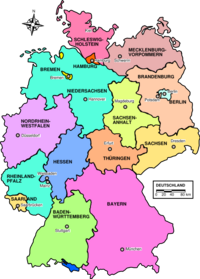  With over 82 million inhabitants, it comprises the largest population among the member states of the European Union and is home to the third-highest number of international migrants worldwide. The capital of Germany is Berlin. Germany (Deutschland) is a Federal Republic consisting of sixteen states, known in German as Länder (singular Land). Since Land is the literal German word for "country", the term Bundesländer (federal states; singular Bundesland) is commonly used colloquially, as it is more specific, though technically incorrect within the corpus of German law. The peoples of the states are the nation of Germany. The governments of the states are part of the authority of Germany. The states have many devolved powers including nearly full control of the education system including universities. Different states differ considerably as to how they exercise this control. Under the Basic Law (Grundgesetz) the exercice of governmental powers and the fulfilment of governmental responsibility is incumbent upon the individual Länder as far as the Basic Law does not provide for or allow for any other arrangement. The Basic Law contains a few fundamental provisions on questions of education, culture and science: thus for example it guarantees the freedom of art and scholarship, research and teaching, the freedom of faith and creed, free choice of profession and of the place of training, equality before the law and the rights of parents. The entire school system is under the supervision of the state. Unless the Basic Law awards legislative powers to the Federation, the Länder have the right to legislate. Within the education system, this applies to the school sector, the higher education sector, adult education and continuing education. Administration of the education system in these areas is almost exclusively a matter for the Länder.
States of GermanyThe 16 Länder are called in English (and German if different):
Those states in bold have at least 5 million people (and of these, four have 10-20 million) - in other words, they are larger than many European countries. Education in GermanyEducation in Germany include
Preprimary education Pre-primary education and care is part of the child and youth welfare sector. In most Länder, responsibility for pre-primary education and care lies with the social ministries. From three to six years, children can attend Kindergärten which are mainly run by non-public bodies (primarily churches and welfare associations) and to which parents are required to contribute, despite the allocation of major public subsidies and reliance on other funds. Compulsory schooling Full-time education is compulsory from between the ages of 6 and 15 or 16 (depending on the Land), and part-time education is compulsory until the age of 18 for those who do not attend a full-time school.
Secondary education includes four types of schools based on a pupil's ability as determined by teacher recommendations:
There are also Förderschulen (schools for the mentally challenged and physically challenged). One in 21 students attends a Förderschule. Post-compulsory education and post secondary level education Once pupils have completed compulsory schooling – generally when they reach the age of 15 – they move into upper secondary education. The type of school entered depends on the qualifications and entitlements obtained at the end of lower secondary education. The range of courses on offer includes full-time general education and vocational schools, as well as vocational training within the duales System (dual system). In order to enter a university, high school students are required to take the Abitur examination. The courses of education provided at vocational schools within the upper secondary level lead to a vocational qualification for skilled work as qualified staff, e.g. in the anerkannte Ausbildungsberufe (recognised occupations requiring formal training) or the assistant occupations; however, students possessing a diploma from a vocational school may also apply to enter higher education.
For more detailed information see Eurydice, Organisation of the Education System in Germany, 2009/2010 On the German education system see also http://en.wikipedia.org/wiki/Education_in_Germany A glossary with explanation of different school types is available at http://www.kmk.org/fileadmin/doc/Dokumentation/Bildungswesen_en_pdfs/en-2009.pdf Schools in GermanyFor a full list of school in Germany visit http://en.wikipedia.org/wiki/List_of_schools_in_Germany Further and Higher educationHigher education (HE) studies in Germany are offered at three types of Higher Education Institutions (HEI)
Studies in all three types of institutions have traditionally been offered in integrated "long" (one-tier) programmes leading to Diplom- or Magister Artium degrees or completed by a Staatsprüfung (State Examination). Within the framework of the Bologna-Process one-tier study programmes are successively being replaced by a two-tier study system. Since 1998, a scheme of first- and second-level degree programmes (Bachelor and Master) was introduced to be offered parallel to or instead of integrated "long" programmes. The Berufsakademie – offered by some Länder – forms part of the tertiary sector and combines academic training at a Studienakademie with practical in-company professional training in keeping with the principle of the dual system. According to the International Standard Classification of Education (ISCED), the Fachschulen, the Fachakademien in Bayern and the two- and three-year schools in the health sector (Schulen des Gesundheitswesens) are also part of the tertiary sector. Fachschulen are continuing vocational education institutions in the tertiary sector that, as a rule, require the completion of relevant vocational training in a recognised occupation requiring formal training and subsequent employment Higher Education Institutions are either state or state-recognized institutions. In their operations, including the organization of studies and the designation and award of degrees, they are both subject to higher education legislation. For detailed information on the German Higher Education System and the different types of higher education institution see http://www.daad.de/deutschland/hochschulen/hochschultypen/00414.en.html
Universities in GermanyFor a full list of Universities in Germany visit http://www.daad.de/deutschland/hochschulen/hochschulprofile/00597.en.html?show=liste Polytechnics in GermanyColleges in GermanyEducation reformSchoolsPost-secondaryAdministration and financeThe political and administrative hierarchy in the Federal Republic of Germany is made up of three levels: 1) Federation; 2) Länder; and 3) local authorities (Kommunen). According to the Basic Law (Grundgesetz), educational legislation and administration are primarily the responsibility of the Länder (in a system comprising the Land Ministries of Education, Cultural affairs and Science, the regional authorities (Bezirksregierung/Oberschulamt) and the lower-level school supervisory authorities (Schulamt). This particularly applies to the school system, higher education and the adult education/continuing education sector. Decisions on the financing of education are taken at all three levels, but over 90 per cent of public expenditure are provided by the Länder and the local authorities. The Länder cooperate with each other within the framework of the Standing Conference of the Ministers of Education and Cultural Affairs of the Länder in the Federal Republic of Germany (abbr.: Kultusministerkonferenz – KMK) on matters of importance for all Länder. The responsibilities of the Federal Government in education are defined in the Basic Law. Among these responsibilities is the legislation concerning the admission to higher education institutions and the degrees they confer, as well as the financial assistance for individual training, including promotion of younger academic staff. The Basic Law also provides for particular forms of cooperation between the Federation and the Länder, such as that which occurs in the sector of the promotion of research.
SchoolsPre-primary sector Pre-school education is not a part of the state school system, and Kindergarten attendance is not, as a general rule, free of charge. Publicly-maintained Kindergärten (maintained by the local authorities) are financed by the local authority (Kommune), by the Land (subsidies to cover personnel and material costs etc.) and through parental contributions. Meanwhile, Kindergärten that are privately maintained (by churches, parents' initiatives etc.) are also financed by the local authority (Kommune), by the Land and through parental contributions, and, in addition, by the maintaining body's own resources. The financing by the Länder may encompass subsidies to cover investment, personnel and material costs etc. Primary and secondary sector Supervision of the school system (general education and vocational schools) is the responsibility of the Ministries of Education and Cultural Affairs in the Länder in their capacity as the highest educational authorities. The planning and organisation of the overall school system is the responsibility of the Ministries of Education and Cultural Affairs and the subordinate school supervisory authorities. The Länder are in charge of organising the school structure and determining the content of courses and teaching objectives. Attendance of public-sector schools is free of charge. The public-sector school system is financed on the basis of a division of responsibilities between the Länder and the Kommunen (local authorities). While the latter bear the costs of non-teaching staff and the material costs, the Ministries of Education and Cultural Affairs of the Länder are responsible for the teaching staff payroll. The possibility of schools managing their own budgetary funds has increased in recent years on the basis of amendments to the school legislation. In the majority of Länder, schools are already able to determine their own use of resources for one or several types of expenses (e.g. learning and teaching aids) within the budget allocated by the maintaining body. Initial approaches are also in place for the autonomous use of the personnel resources allocated. The maintaining bodies of privately-maintained schools receive some financial support from the Länder, in various forms.
Post-secondaryQuality assurance, inspection and accreditationSupervision of the school system (general education and vocational schools) is the responsibility of the Ministries of Education and Cultural Affairs in the Länder as the highest educational authorities, as stated in the Basic Law (Grundgesetz). The school legislation of most Länder provides for measures of external and internal evaluation beyond state supervision. The Länder have taken a number of evaluation measures which combine various quality assurance and quality development procedures. These measures are embedded in overall strategies of the individual Länder for quality evaluation and quality assurance which, amongst other measures, include
The evaluation systems for schools in the Länder are in line with the Educational Standards (Bildungsstandards) for the primary and secondary sector adopted by the Standing Conference of the Ministers of Education and Cultural Affairs in order to thoroughly develop and assure the quality of instruction and school education on the basis of binding standards. These Länder-spanning target criteria are in most Länder complemented by the provisions of the so-called frameworks for school quality which provide schools with indicators of school and teaching practice quality. The schools in the Länder are evaluated by external evaluation agencies and inspection systems in accordance with these criteria. It is the main task of the Institut zur Qualitätsentwicklung im Bildungswesen – IQB (Institute for Educational Progress) to review whether the educational standards have been met in the Länder. The Federation and the Länder have agreed on a biennial indicator-based report Education in Germany as a continuous, data-based, problem-centred examination of the German education system.
Quality assurance for in-company vocational trainingQuality assurance in in-company vocational training is achieved mainly through laws and regulations and through the recommendations of the board of the Federal Institute for Vocational Training - BIBB . The Vocational Training Act (Berufsbildungsgesetz – BBiG) places a high value on quality assurance and quality development. It contains a comprehensive set of instruments for assuring quality in vocational education and training which ranges from the establishment of uniform national standards for training and examinations in the training regulations and further training regulations of the Federation to the responsibilities of the competent bodies with regard to ensuring the personal and technical aptitude of the instructors and the suitability of the training premises. SchoolsPost-secondaryInformation societyThe Initiative D21 is a public-private partnership initiative aimed at improving the general conditions necessary to move on successfully into the information and knowledge society and to make Germany more internationally competitive. More than 200 representatives of enterprises, associations, parties, political institutions and other organizations are currently involved, including board members from companies such as Alcatel, AOL, Cisco Systems, debitel, IBM, Microsoft, Siemens and TNS Infratest. They are assisted by an Advisory Council. Their commitment is channeled toward promoting skills in the use of information and communications technologies among specific social groups, as well as in schools, government agencies, associations and enterprises. The Initiative D21 is pursuing these objectives in some 40 practical projects, each headed by a representative of business and politics. The Initiative is organized into three subject areas ("steering groups"):
The annual "(N)ONLINER Atlas" is the largest study on the use of the Internet in Germany, see (N)ONLINER Atlas 2011 report
The ICT strategy, Digital Germany 2015, sets out the priorities, tasks and projects for the period up to 2015. It aims to do the following:
ICT in education initiativesICT initiatives in education in Germany are determined at Land level, resulting in a highly fragmented picture which is difficult to map. Since the mid-90s the Federeal Ministry of Education has been trying to adpat the German schools to the digital age. As they are not able to directly interfere in the curriculum, these initiatives mainly support ICT integration in education by providing equipment and technical advice. The main aims of these initiatives are
In 1996 The Federal Ministry Education and Research (in cooperation with Deutsche Telekom) has created the Schulen ans Netz association with the first mission of connecting all German schools to the Internet, by the end of 2001. After that, Schulen ans Netz was step by step transformed a competence centre covering all aspects of the use of new media in schools. The scope of Schulen ans Netz is nationwide and the focus of the work lays on identifying and disseminating Good Practice. The main emphasis is to offer concrete online tools, content and support for teachers, school leaders, school authorities and parents. These services shall simplify teaching and learning with ICT in daily school life.
Virtual initiatives in schoolsLehrer-onlineLehrer-online (teachers-online) is the national German school server, funded by the national ministry for education and research.The main tasks of Lehrer-online are the provision of information and teaching material for schools (primary schools, secondary schools, vocational schools). New media is a strong focus of the programme. Lehrer-online is part of an online network www.schulen-ans-netz.de, financed by the Federal Ministry of Education and Research (BMBF) and, in its first phase, sponsored by the Deutsche Telekom as well. Some German federal states have similar and linked initiatives, e.g. Bavaria, Lower Saxony etc.. Like all the web-based services, provided by the Schulen ans Netz, this portal was also supported by a team of education experts, IT-specialists and teachers who were knowledgeable of the current educational needs. The services of Lehrer-Online include:
Virtuelle SchuleThe Virtuelle Schule (Virtual School) is an initiative of the non-profit association Virtual School e. V. and include three internet platforms:
They address mainly teachers (by providing relevant material and content for their lessons and teaching practice), but there is also space for access and participation on the part of students and parents It might be further investigated as a potential exemplary. The internet platfom generates from a previous initiative (end of the 90s) at the Clavius-Gymnasium in Bamberg LizzyNetLizzyNet is a portal and community with information, communications and learning tools especially developed for girls The concept of the platforms and communities of LizzyNet are made available on request. In both communities the creation of national groups from other countries is welcome. Also groups for international exchange can be created Exil-ClubExil-Club is an online learning environment that engages with the subjects of exile, migration and intercultural education. The content as well as the working platform of the Exil-Club can be used by European school projects dealing with topics from the Exil-Club. Lo-net and Virtuelles Gymnasium SonthofenThe Sonthofen Gymnasium, in Sonthofen is an interesting example of adoption of the lo-net services to create virtual classrooms and change the traditional way of teaching-learning in school. Lo-net stands for "lehrer-Online-Netzwerks" (teacher on line network) and is a service provided by Schulen and Nets - free of charge - for schools. The second version of lo-net was launched in 2006, and provides for the possibility to create virtual learning environments (virtual classrooms and groups) where teachers and students can work and where it is possible to exchange artefacts and materials. As mentioned in the Lo-net website homepage "“LO-Net makes true the dream of the virtual school: teachers and learners work together in classes and courses online, school organization and work with parents take place in the network. Already more than 6,500 schools nationwide use the web-based learning and work lo-net platform, the comprehensive and innovative solution for schools.” Virtuelles Gymnasium Sonthofen: in the Sonthofen Gymansium, which has subscribed to the lo-net system, all teachers and students have their own account, which is also an email address. In 2006 Many teachers in the school were already giving their lessons using lo-net, including homeworks, opportunities for additional practice, etc. Students can also work with their classmates, exchange material, i.e. upload and download presentations. Forum and chats are also available. The learning environment access is controlled but can be opened either to other classrooms, as well as to parents etc.. (it would be interesting to see how the situation has developed after 2006) Deutsche Fernschule (German Correspondance School)The Deutsche Fernschule is an important correpondance school for expat children (6 to 10) has traditionally avoided the use of internet, given also the very young age of the target group. A pilot project has however been recenlty launched, and might deserve some further investigation. Info retrieved from http://www.expatica.com/es/family/kids/The-virtual-classroom_16680.html Other potential interesting casesThe report on a EU study visit at Schulen ans Nets (2004) of Group C (Implementation of "E&T 2010" work programme) "ICT in education and training", indicate some potential interesting schools, innovatively applying ICT in their daily practices. Virtual initiatives in post-secondary educationLessons learntGeneral lessonsNotable practicesReferences
>> Main Page |